You have been pitched AI for two years now. A demo on a clean screen. A task that works perfectly because someone chose the example. A post from someone who turns out to be selling a course. After enough of those, most owners land in the same place: open to the idea, and unable to tell what would survive contact with an actual Tuesday.
Meanwhile the week keeps leaking. Ten minutes to chase a quote, twenty quotes a month, so three hours of follow-up that either eats your evenings or quietly does not happen. That arithmetic is where the useful question lives: which parts of your business keep paying you back after the first month, and which save twenty minutes once and never again.
Why some automation keeps paying and some stops
Two kinds of automation get sold to businesses like yours. The first kind saves time on a task. It drafts the email, summarises the meeting, renames the files. Honest work, and flat. It saves the same minutes in month twelve as it did in month one, and the day the subscription stops, the saving stops with it.
The second kind closes a leak in a process that runs whether or not anyone is watching. An enquiry answered in two minutes at 9pm becomes a job that used to go to whoever replied first. A quote followed up on day three, every time, without anyone having to remember, becomes work that used to evaporate. These keep paying because the thing they fixed was a hole, and a hole leaks continuously. Every month the automation runs it catches more, and the record it builds of what customers actually ask makes the next month sharper.
Notice what the second kind actually removes. Sometimes it is a task. Sometimes it is a delay, the dead hours between a customer asking and anyone answering. Sometimes it is a decision you should never have been making at 10pm, like whether the quote went out or the review got a reply. Task, delay, decision: if an automation removes one of the three at a point where money moves, it is probably an asset.
The ones that stop after the first month tend to fail the same way. The process underneath was never fixed, so the exceptions pile up. Someone on the team quietly goes back to doing it by hand. Six months later the tool is a login nobody opens, and the software gets blamed for what was a process problem. The pattern we tend to see is that the technology was fine. The thinking underneath it was never done.
The shift underneath all this is real, for what that is worth. Data from the Australian Bureau of Statistics shows almost one in two Australian businesses, 46 per cent, now finding savings and efficiencies through innovation, including AI, with adoption accelerating sharply from the very low rates recorded in 2021-22. If you want the sober version of where things stand, the National AI Centre's adoption insights series tracks it quarter by quarter, and nobody tries to sell you a course at the end.
The difference between saving time once and building an asset
An hour saved is spent once. You feel it that afternoon, and by the next week it is gone. An asset behaves differently. It keeps producing after you stop paying attention to it, and in the good cases its output grows. The automations that compound tend to do it through a short list of levers, and they are worth naming plainly, because this list is the map for everything this newsletter covers this year.
- Cheaper plumbing. The second automation costs less than the first, because the connections between your systems and the documentation of how things work already exist.
- Speed that wins data. Answering in minutes wins jobs, and every job teaches the system more about what your customers ask, which sharpens the next answer.
- Consistency at volume. The hundredth enquiry gets the same quality as the first, and as volume grows the gap between you and the competitor doing it by hand widens on its own.
- Forced documentation. You cannot automate a process without writing it down, and a business with its processes written down is a business you can delegate in.
- Reinvested hours. The time that comes back has to be pointed at something, or the week absorbs it and the saving evaporates.
- Reputation. Fast, consistent follow-up turns up in your reviews, and reviews lower what you pay to win the next customer.
Each of those gets its own issue later in the year, because each has a failure mode worth understanding. For now the point is simpler. When you assess any automation, ask which lever it pulls. If the honest answer is that it saves the same twenty minutes forever, that can still be worth buying. Price it as a flat saving, and do not let anyone sell it to you as an asset.
Start where the money leaks
Ask which part of a business to automate first and the answer is remarkably consistent across trades, clinics, agencies and e-commerce. It is the sales and marketing pipeline, because that is where the money leaks. The architecture barely changes from business to business. Get leads, qualify them, build trust, deliver, look after people afterwards, retarget. Timing across those stages is the whole game: how fast you get back to an enquiry, whether a lead goes cold between steps, who follows up the quote, when anyone last contacted a finished customer.
Automation compounds hardest where it closes a leak, and the leaks in most businesses at your size sit between the stages. Enquiries answered too slowly. Leads that go cold between steps. Quotes nobody follows up. Customers never contacted again. Fixing these takes speed, accuracy and consistency at a volume no person sustains for long, which is exactly the work automation does well. Brilliance is optional.
Volume is the part people lose. Anyone can give five enquiries a day a fast, careful answer. Fifty a day, every day, including Sunday, is where the cracks appear, and where a well-built system pulls away.
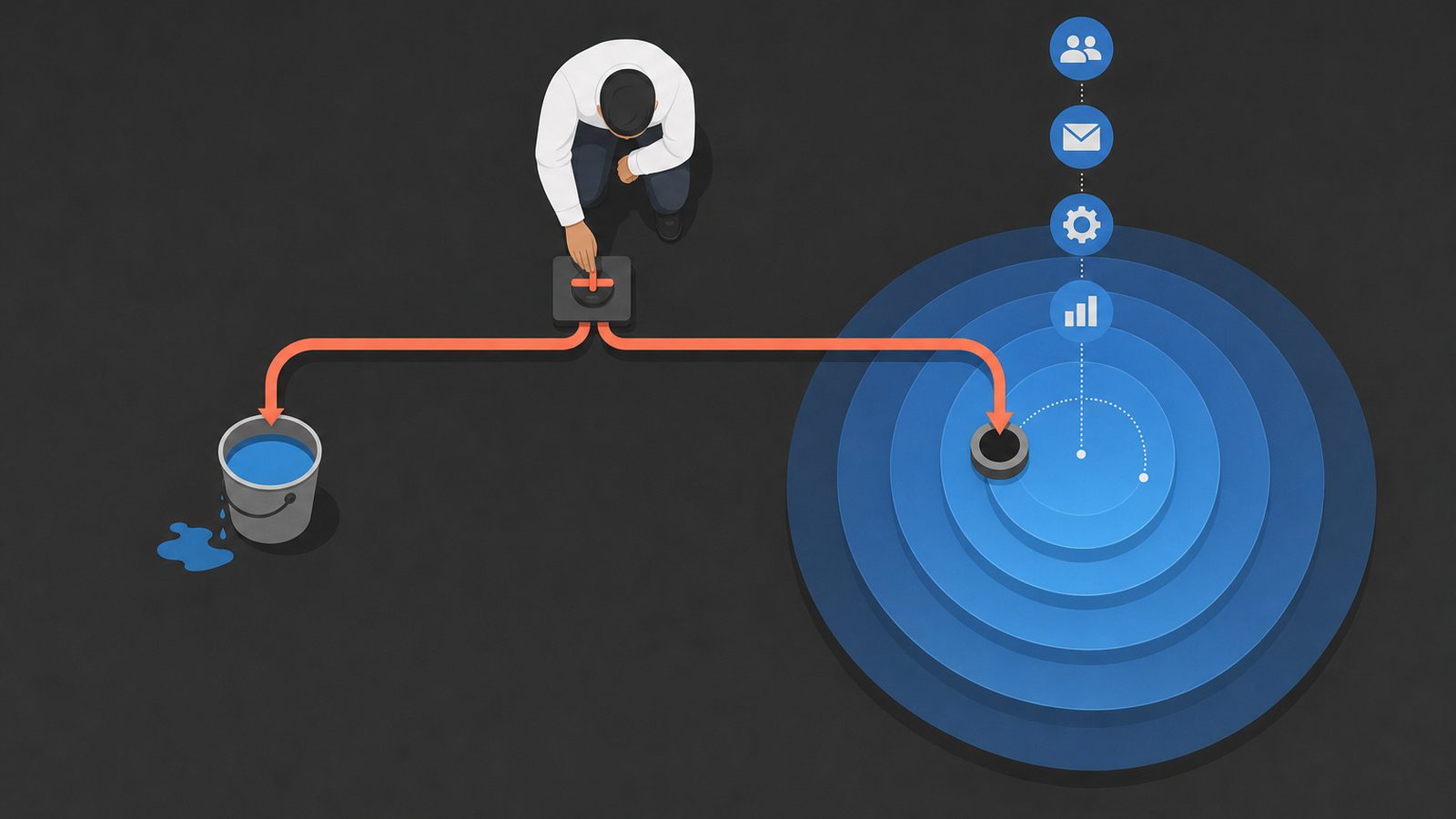
This is also why marketing deserves a wider definition than the ad account. Marketing is your brand, your customer service, your post-purchase care, how you nurture leads, your website, your reputation. You can run a strong return on ad spend and a tidy cost per click and still pour water into a leaking bucket, because the ads are one stage of six. If you want the concrete version of what closing one of these leaks looks like, how automated client follow-up works is the short read.
The 80 per cent that never appears in a demo
Here is the claim this whole year of writing rests on. About 80 per cent of building automation that saves money and lasts is design: deciding what the process actually is, where it leaks, who owns an exception, what counts as done. About 20 per cent is the coding and technical work. The build is the easy end.
That ratio explains most of what owners find confusing about this technology. It is why most automation projects fail on process rather than software. It is why the first automation costs more than people expect, because the design work happens once and cannot be skipped. And it is why a demo proves almost nothing. A demo is the 20 per cent with the 80 per cent assumed away. Bill Gates put the underlying point cleanly in The Road Ahead: "The first rule of any technology used in a business is that automation applied to an efficient operation will magnify the efficiency. The second is that automation applied to an inefficient operation will magnify the inefficiency."
The practical consequence is blunt. You cannot automate a process you cannot describe. If the quote follow-up lives in your head and changes depending on the customer, the first job is writing it down, and that job exists whether or not you ever buy software. This design work, sitting with an owner and pulling the real process out of their head, is most of what we do at InterMeta, and it is the part no demo will ever show you.
It is also where the honest limits live. If a process runs twice a month and takes ten minutes, leave it manual, because the arithmetic will never pay. If nobody can agree on what counts as done, no tool will settle that argument for you. Automation magnifies whatever is already there. That is the whole trick, and it is why the thinking has to come first.
How to tell an asset from a liability waiting to break
An automation is an asset when three things are true. The process underneath it is described in writing. A named person owns it when it breaks. And its value grows with volume instead of sitting flat. Miss any one of the three and you are holding a liability.
The rot is quiet. A price list changes and the automation keeps quoting the old one. The person who understood the setup leaves. A form gets renamed, enquiries stop filing themselves, and nobody notices for a fortnight. Unowned automation does not fail loudly. It fails confidently, doing the wrong thing at scale while everyone assumes it is fine. Someone has to own the exceptions: the odd job, the customer who does not fit the pattern, the edge case the build never anticipated. The automation handles the volume. A person owns the edge.
This hands you a fast test for the next AI claim that lands in your feed, and it takes about ten seconds. Ask what process the thing sits inside, and whether the person selling it can describe yours. Ask who catches it when it is wrong. Ask whether it gets more valuable the longer it runs, or saves the same minutes forever. A claim that survives those questions deserves an hour of your time. Most of what is being sold right now does not survive them, and now you can see why.
What a year of automation actually costs
No honest number exists without a conversation about how your business actually runs, so anyone quoting you a build price before asking about your process is pricing the 20 per cent and ignoring the 80. What can be stated plainly is the shape of the cost.
The first automation is the expensive one, and that is the point. The mapping, the exception decisions, the definition of done: that work happens once, and every later build stands on the plumbing and documentation the first one produced. The second automation is cheaper. The fifth is cheaper again. The running cost is real but modest. Someone owns the thing, exceptions get handled, and it gets updated when the business changes. Treat it like a vehicle: an asset with maintenance, where the maintenance is what keeps it an asset.
Most of the businesses we work with start with one automation and expand once they can see it working. Starting small is how you find out whether the thing was worth building. The return is your own arithmetic: hours returned per week, multiplied by what those hours cost you, plus the value of the leaks that got closed. If you want a framework for running those numbers before you spend anything, working out the return on an automation walks through it.
One warning, because it is where good projects quietly die. Hours that come back and get absorbed by the week are a saving that evaporates. Where the freed time goes is a decision, and the businesses that compound are the ones that make it deliberately. Over the coming months this newsletter will take each piece of this apart: why the first automation is the expensive one, where the freed hours actually go, who owns the thing when it breaks, and how to sequence a full year of builds so each one makes the next cheaper.
None of this asks you to become technical. Describing a process, spotting where it leaks, deciding what counts as done: those are the same calls you make when you price a job or run a team, and you have been making them for years. The technology is the easy end. If you are working through this in your own business, hit reply and tell me where it is sticking. I read every one.